
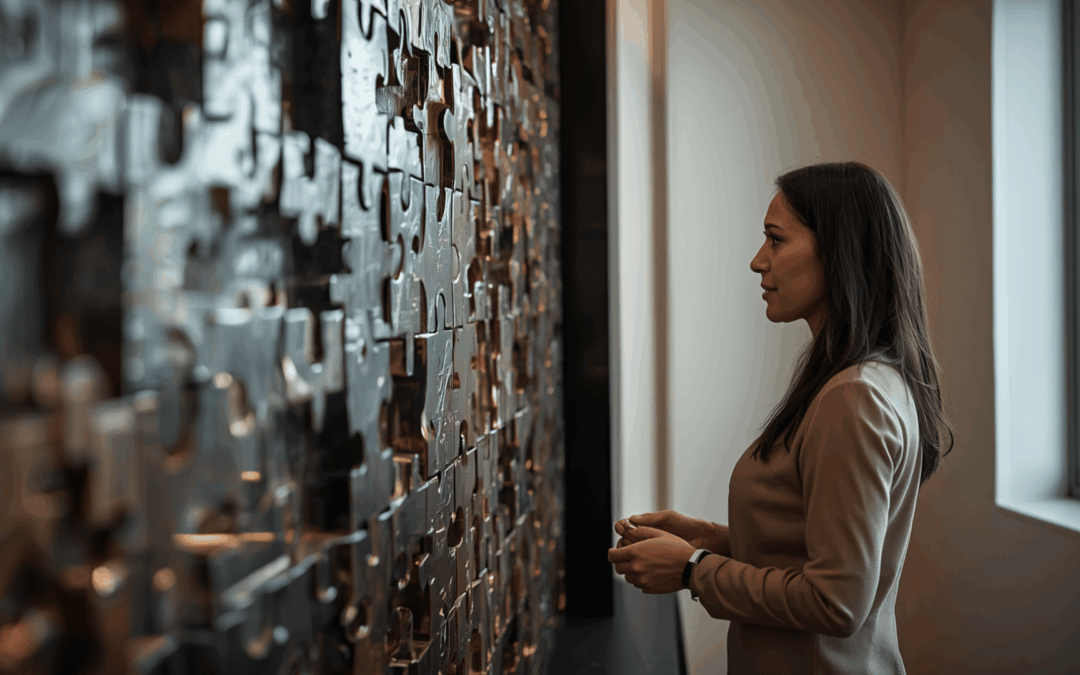
One Missing Piece Doesn’t Mean the Picture Is Broken
Maybe you have spent years staring at the missing piece.
The relationship that ended.
The business that failed.
The money you lost.
The person who left.
The opportunity you missed.
The family you thought you would have.
The diagnosis you never expected.
The betrayal you did not see coming.
The version of your life you were certain would exist by now.
And because that one piece is missing, you have started looking at the entire picture as though something is wrong with it.
But one missing piece does not make the entire picture incomplete.
Sometimes we become so focused on what is missing that we stop seeing everything that remains.
And everything that could still be created.

What Is the Missing Piece for You?
Not the socially acceptable answer.
The real one.
What happened that you are still organizing your life around?
What hurt are you still protecting?
What disappointment quietly changed the decisions you make?
What happened years ago that still gets a vote in what you do today?
Because you can move forward chronologically without moving forward neurologically.
Your life continues.
Your responsibilities continue.
Your business continues.
Everyone assumes you have moved on.
But part of your system may still be responding to something that happened years ago.
That matters.
Especially when you are trying to build what comes next.
You Can Be Successful and Still Be Stuck
This is one of the contradictions I see in high performers.
You can be extraordinarily functional and still have places where your life has stopped moving.
You can run the company.
Raise the children.
Lead the team.
Make the money.
Solve everyone else’s problems.
And still avoid the conversation you need to have.
Still refuse the opportunity you secretly want.
Still stay in the wrong relationship.
Still hesitate before becoming more visible.
Still question whether you are qualified for the room you have already earned your way into.
Still pull back every time life begins asking you to become bigger.
From the outside, it may not look like being stuck.
That is because high performers can become exceptionally good at functioning around restriction.

What Happened to You Is Not the Same as Who You Are
Pain can become part of identity without us realizing it.
Something happens.
Your brain learns from it.
You adapt.
You protect.
And eventually the adaptation becomes so familiar that it starts feeling like personality.
I’m just cautious.
I’m independent.
I don’t trust people easily.
I work better alone.
I’m not good at putting myself out there.
I don’t need anyone.
Maybe.
Or perhaps your system learned something.
Do not trust.
Do not risk.
Do not need.
Do not be seen.
Do not get too excited.
Do not let it happen again.
Those responses may once have served a purpose.
The important question is whether they are still serving the future you say you want.
Your Brain Is Designed to Learn From Pain
Your brain is predictive.
It continuously uses previous experience to help determine what deserves attention and what may represent risk.
That is useful.
It helps keep us alive.
But the same protective learning can become expensive when yesterday’s experience begins controlling tomorrow’s decisions.
A business failure can make the next investment feel dangerous.
A betrayal can make intimacy feel unsafe.
Public criticism can make visibility feel threatening.
Financial loss can turn every opportunity into something that must first survive endless analysis.
Rejection can make asking feel more dangerous than remaining invisible.
Your conscious mind may say:
I want more.
Your protective systems may be saying:
More is where we got hurt.
Now we have a conflict.
And that conflict can look remarkably like procrastination, inconsistency, self-sabotage or lack of confidence.
Is Your Brain Getting in the Way of Your Future?
This is the question.
Not:
What’s wrong with me?
Not:
Why can’t I just get over it?
And certainly not:
Why can’t I be more disciplined?
Ask:
Is something my brain learned during a painful chapter still influencing the life I am building now?
That is a very different question.
Because now we can stop judging the behavior and begin examining the system producing it.
Pain Can Become a Prison—or Information
You have been through things.
Maybe things nobody knows about.
Maybe things everyone knows about but nobody understands.
You cannot rewrite that history.
But you can decide whether the rest of your life will remain organized around it.
There is a difference between remembering pain and continuing to live from it.
One acknowledges what happened.
The other gives what happened authority over what happens next.
That is where your future becomes interesting.
Because the goal is not to pretend the missing piece never existed.
The goal is to stop allowing one missing piece to define the entire picture.

What If the Thing That Hurt You Becomes Part of How You Help Someone Else?
There is another possibility.
Your hardest chapter may eventually give you language for someone else’s.
Not because suffering is required for purpose.
Not because everything happens for a reason.
And not because pain should be romanticized.
But because experience can create perspective.
The thing you once hid may become the reason someone finally feels understood.
The failure you were embarrassed about may become the story another founder needs before she tries again.
The period when you could barely put one foot in front of the other may become the reason you recognize someone who is quietly struggling while everyone else thinks she is fine.
Your scar does not automatically make you an expert.
But when experience is integrated with knowledge, discernment and purpose, it can become extraordinarily useful.
Pain does not have to become your identity.
It can become information.
It can become compassion.
It can become conviction.
It can become a voice.
It can become hope.
But You Have to Decide What Happens Next
This is where the conversation becomes uncomfortable.
Because eventually the question is no longer only:
What happened to me?
It becomes:
What am I going to do with what happened to me?
Will you keep shrinking your life around it?
Will you continue protecting yourself from something that is no longer happening?
Will you keep postponing visibility?
Connection?
Growth?
Love?
Leadership?
The business?
The book?
The stage?
The opportunity?
Or will you begin creating evidence that your future does not have to look like your past?
The Missing Piece May Not Be What You Think
Maybe you have been looking for confidence.
Motivation.
Discipline.
Closure.
Permission.
Another strategy.
Another certification.
Another person to tell you that you are ready.
But perhaps the missing piece is different.
Perhaps it is capacity.
The neurological capacity to tolerate uncertainty without retreating.
To experience discomfort without automatically interpreting it as danger.
To become visible without needing everyone to approve.
To make a decision without rehearsing every possible catastrophe.
To receive an opportunity without immediately finding a reason you cannot take it.
To allow your future to become larger than the history your brain has been using to predict it.
That changes the conversation completely.

Your Future Needs a Vote Too
Your past has evidence.
That is why it can be persuasive.
It can show you exactly where things went wrong.
Your future cannot do that yet.
It has not happened.
So eventually you have to decide whether every future decision will require approval from your past.
Maybe it is time for something else to get a vote.
The person you are becoming.
The business you want to build.
The people you could help.
The relationships you have not created yet.
The work that still has your name on it.
The life that has not happened yet.
Complete Does Not Mean Perfect
Maybe there will always be a missing piece.
A person you wish were still here.
An answer you never received.
An apology that never came.
A version of your life that never happened.
Completion does not require pretending otherwise.
Sometimes completion means being able to look at the empty space without allowing it to erase everything surrounding it.
Look at the entire picture.
Look at what survived.
Look at what you built.
Look at who you became.
Then look at the blank spaces that remain.
Those are not necessarily evidence that your life is incomplete.
They may be space for what comes next.
So take the hurt.
Take the experience.
Take the chapter you would never have chosen.
Learn from it.
Integrate it.
And when you are ready, use your voice.
Because somewhere there may be someone standing inside the chapter you already survived.
Your story does not need to keep you small.
It may become part of the reason someone else realizes they do not have to stay small either.
And perhaps the missing piece was never about completing the old picture.
Perhaps it was about finally giving yourself permission to create a new one.
—
Is Your Past Still Making Decisions About Your Future?
If you know what you want next but repeatedly find yourself pulling back, procrastinating, overthinking or failing to execute, stop assuming you simply need more discipline.
Look at the system.
My work with founders, entrepreneurs and high performers examines neurological load, regulation, capacity and the patterns influencing execution.
Because sometimes the next level does not require pushing harder.
It requires understanding what is still pulling you backward.
— Simone Fortier