

How Grief Changes the Brain—and Why You Don’t Feel Like Yourself
Grief changes more than your emotions. It can change your memory, nervous system, identity, physical health, and ability to function.
You probably remember the moment.
The phone call.
The hospital room.
The message you never wanted to receive.
The first time you saw the empty chair.
The unbearable silence where a familiar voice used to be.
Most people are taught that grief is an emotion.
You cry.
You hurt.
You miss them.
Eventually, you are expected to move on.
But grief is not simply sadness.
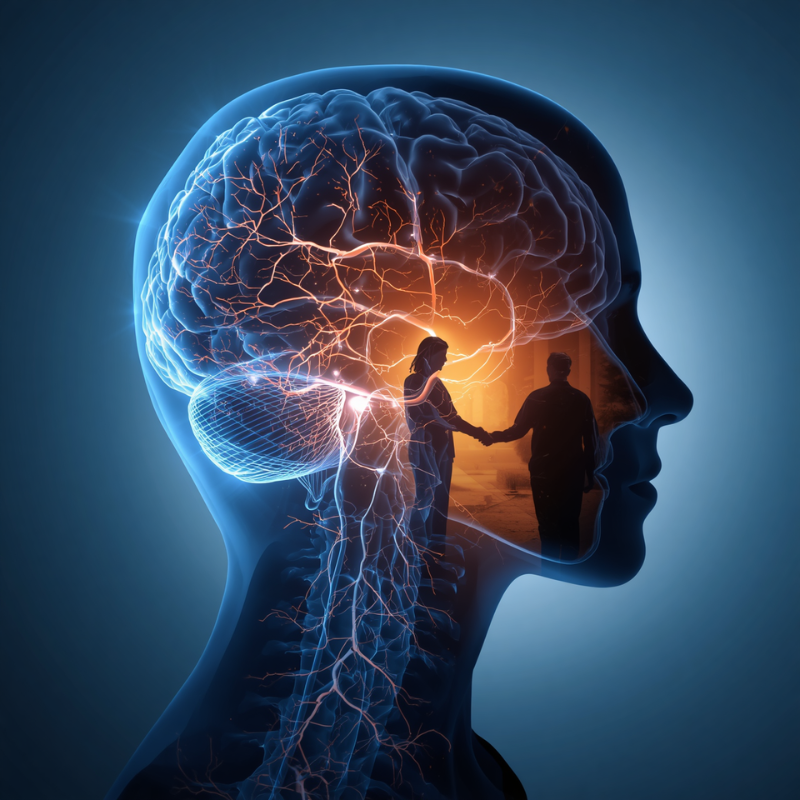
Grief is a neurological event.
Grief changes the brain by disrupting its learned expectations of safety, connection, identity, and the future. This neurological load can affect memory, concentration, sleep, pain, emotional regulation, energy, and daily performance.
You are not simply mourning a person.
Your brain is learning how to function in a reality it did not predict.
That is why you may not feel like yourself.
Your Brain Still Expects Them to Be There
Your conscious mind understands what happened.
They are gone.
But another part of your brain is still operating from years—or decades—of learned experience.
You reach for your phone to tell them something.
You expect to hear their voice.
You think, “I need to ask them about that.”
For a fraction of a second, you forget.
Then reality returns.
This is not weakness.
It is prediction.
The brain constantly uses previous experience to anticipate what will happen next. The people closest to us become part of that prediction system.
Your brain learns:
When something good happens, I call them.
When I feel afraid, I turn to them.
When I enter the house, they will be there.
When the family gathers, they will sit in that chair.
A deeply loved person is not stored in your brain as one memory.
They become part of your brain’s map of safety, attachment, routine, identity, and future expectation.
When they die, that internal map no longer matches reality.
Neuroscientist Mary-Frances O’Connor describes grieving as a form of learning. The brain must repeatedly reconcile the vivid knowledge that the person exists in memory with the reality that they are no longer physically accessible.
You are not refusing to let go. Your brain is repeatedly discovering that the world has changed.
Grief Is a Brain-and-Body Stress Response
Grief is emotional.
But it is not only emotional.
Bereavement can affect sleep, appetite, concentration, stress hormones, immune activity, cardiovascular function, and autonomic regulation. Research has identified relationships between bereavement and changes in cortisol, inflammation, sleep, and other physiological stress responses.
This helps explain why people experiencing grief often say:
“My entire body hurts.”
“I cannot think clearly.”
“I am exhausted, even after sleeping.”
“I walk into a room and cannot remember why.”
“I cannot tolerate the pressure I handled before.”
“I do not feel like myself.”
These responses are not evidence of emotional weakness.
They are evidence of load.
The brain is using significant resources to process the loss, monitor threats, manage memories, regulate emotion, and rebuild its expectations of daily life.
That can leave fewer resources available for executive function.
Focus becomes harder.
Decisions feel heavier.
Memory becomes less reliable.
Ordinary responsibilities require more effort.
You may still be functioning.
But your system is working much harder to produce the same result.
Why Grief Can Affect Memory and Concentration
Grief can create what many people describe as brain fog.
You lose your train of thought.
Forget familiar information.
Struggle to organize tasks.
Read the same paragraph repeatedly.
Walk into a room without remembering why.
This does not automatically mean something is permanently wrong with your memory.
Attention and memory depend on available neurological resources. When the brain is managing disrupted sleep, emotional distress, heightened vigilance, intrusive memories, and constant adaptation, fewer resources may be available for learning, recall, planning, and decision-making.
The information may never be encoded properly because your attention was already overloaded.
This distinction matters.
You are not necessarily losing your intelligence.
Your brain may have less capacity available to access it.

Why Emotional Loss Can Feel Like Physical Pain
The phrase “heartbreak hurts” is not merely poetic.
Brain-imaging research suggests that reminders of a deceased loved one can engage regions involved in distress, salience, attachment, reward, and pain processing.
This does not mean emotional pain and physical injury are identical.
It means the brain does not dismiss profound social loss simply because there is no visible wound.
Human survival has always depended on connection.
The loss of an attachment figure can therefore register as more than sadness. It can be experienced as the loss of safety, orientation, belonging, and part of the structure through which life made sense.
This is why telling someone to stay busy, think positively, or move forward often fails.
You cannot productivity-hack a nervous system that has lost one of its primary reference points.
The problem is not motivation.
The system is attempting to reorganize.
The Brain Cannot Be Separated From the Body
I do not treat grief as a motivation problem—or reduce it to an emotion that must be managed.
I look at what sustained neurological load may be doing to the person’s ability to sleep, think, regulate, move, recover, and execute.
When neurological load increases, the entire system responds.
Breathing patterns can change.
Sleep can deteriorate.
Pain sensitivity can increase.
Muscles and fascia can become more protective.
Energy and movement can decrease.
Digestion and appetite can change.
The body is not betraying you.
It is adapting to demand.
Fascia is not simply material wrapped around the muscles. It is a highly innervated sensory and force-transmission system that responds to movement, pressure, breathing, protection, and neurological state.
When the nervous system perceives ongoing threat or instability, the body may organize around protection.
That can feel like tightness, restriction, pain, heaviness, fatigue, or an inability to take a full breath.
Grief deserves emotional support.
But the brain and body carrying that grief may also require physiological support.
The body cannot be excluded from a conversation about loss.
Why Memories Become More Intense After Someone Dies
After someone dies, small memories can suddenly become extraordinarily vivid.
The way they laughed.
A phrase they always used.
The sound of their footsteps.
How they ordered their coffee.
The expression on their face when they were trying not to laugh.
Ordinary moments that once seemed insignificant become priceless.
The brain prioritizes information connected to emotion, attachment, and survival. Memories associated with important people are distributed across sensory, emotional, and autobiographical networks.
You do not remember only the person.
You remember who you were with them.
You remember places, routines, conversations, conflicts, celebrations, plans, and private language.
This is why losing someone can feel like losing part of your own history.
Because part of your identity was created in relationship with them.

The Identity Disruption Nobody Warns You About
When someone central to your life dies, you do not only lose them.
You lose the version of yourself that existed with them.
A wife becomes someone different without her husband.
A daughter becomes someone different without her mother.
A parent becomes someone different after losing a child.
A friend becomes someone different without the person who remembered the earliest chapters of her life.
Relationships do more than connect us.
They help organize identity.
You are not exactly the same person with your parents as you are with your children.
You are not the same person with a lifelong friend as you are in a boardroom.
Different relationships give expression to different parts of you.
When a defining relationship ends, the brain must answer questions no one prepared you to ask:
Who am I without this person?
Where does all this love go?
What happens to the future we expected?
Who remembers the person I was when I was with them?
This is not simply moving on.
It is identity reconstruction.
You are learning how to carry the relationship differently while building a life that can no longer include the person in the same physical form.
Why Some People Feel Stuck in Grief
There is no correct timetable for grief.
It is not linear.
It does not move neatly through five predictable stages.
You may function well for weeks and then be destabilized by a song, a smell, an anniversary, or a completely ordinary Tuesday.
For some people, however, the intensity remains persistent and significantly disrupts daily functioning. One clinically recognized pattern is called prolonged grief disorder.
This does not mean the person loved too much.
It does not mean they are emotionally weak.
It may mean the brain is struggling to integrate two conflicting realities:
They should be here.
They are not here.
Research involving people with prolonged grief has found that reminders of the deceased may continue to activate reward and attachment-related regions associated with yearning. In one small functional-imaging study, activity in the nucleus accumbens was associated with greater yearning—not simply with the amount of time that had passed.
Time alone does not necessarily reorganize the system.
The brain requires sufficient safety, capacity, support, and repeated experience to update what it predicts.
Healing Does Not Require Forgetting
Many people resist healing because healing feels like betrayal.
If I stop hurting, did I love them less?
If I laugh again, am I leaving them behind?
If I build a new life, does that erase the one we had?
No.
Healing is not deletion.
The brain does not need to erase a meaningful relationship to adapt to its physical absence.
The connection can change form.
Their advice becomes part of how you make decisions.
Their standards become part of how you live.
Their humor remains inside the stories you tell.
Their courage influences how you respond under pressure.
Their love changes how you love other people.
The relationship moves from an external interaction to an internal influence.
They are no longer physically beside you.
But they remain part of the person you are becoming.

The Goal Is Not to Become Who You Were Before
You may never become the person you were before the loss.
That is not failure.
That person lived in a world where someone important was still present.
Your previous identity, routines, expectations, and future plans were constructed inside that reality.
Loss changes the system.
But change is not the same as destruction.
Some people eventually report greater compassion, clearer priorities, deeper relationships, stronger boundaries, or a more deliberate relationship with life. Researchers sometimes describe positive psychological changes following adversity as post-traumatic growth.
This does not make the loss good.
It does not justify the suffering.
And it should never be used to pressure someone into finding a lesson before they are ready.
Meaning cannot be forced.
It develops as the brain and body regain enough capacity to integrate what happened.
You Do Not Need More Pressure. You Need More Capacity.
Grief can make highly capable people feel inconsistent.
They may still appear functional.
Still working.
Still leading.
Still caring for everyone around them.
Still meeting the expectations no one thought to remove.
But internally, the system is working much harder.
Memory becomes unreliable.
Patience becomes shorter.
Sleep becomes disrupted.
The body remains guarded.
Tasks that were once automatic require conscious effort.
This is often misinterpreted as laziness, depression, lack of discipline, or an inability to move forward.
But execution frequently breaks down neurologically before it breaks down behaviorally.
The answer is not always to demand more from yourself.
Sometimes the first step is to reduce neurological load and restore the resources the brain requires to regulate, recover, and function.
Support may include grief-informed therapy, medical care, restorative sleep, appropriate nutrition, movement, social connection, and brain-based regulation strategies.
There is no single intervention for grief.
There is, however, one critical principle:
A system under extreme load cannot be punished into healing.
It must be given the conditions required to change.
When Grief Begins Affecting How Your Brain Functions
You may still be working.
Still leading.
Still caring for everyone around you.
But you know your brain is not functioning the way it did before.
You cannot focus.
Your memory is unreliable.
Sleep does not restore you.
Small decisions feel unusually difficult.
Your energy disappears without warning.
That is not necessarily a discipline problem.
It may reflect the impact of prolonged neurological load.
The Brain Health Assessment helps identify patterns affecting memory, sleep, focus, emotional regulation, energy, and execution.
The Brain Reset Program then supports the foundational nutritional and neurological conditions the brain requires to function more effectively.
This is not about erasing grief.
It is not a replacement for grief counselling, psychotherapy, or medical care.
It is about supporting the brain and body responsible for carrying the loss.
Start With the Brain Health Assessment
Identify the patterns affecting your brain’s ability to regulate, recover, and perform.
Take the Brain Health AssessmentThe Question That Changes Everything
After losing someone you love, the question is not:
“Why am I still not the person I used to be?”
You are not supposed to be unchanged.
Love changes the brain.
Loss changes the brain.
Every person who becomes part of your emotional architecture leaves a neurological and relational imprint.
The work is not to return to a previous version of yourself.
The work is to become someone who can carry the love without being consumed by the loss.
Someone who remembers.
Someone who continues.
Someone who allows the relationship to become part of their strength, standards, compassion, and future.
You do not move on from someone who changed your life.
You move forward carrying what their life changed in you.
Frequently Asked Questions About Grief and the Brain
Can grief cause brain fog?
Yes. Grief can affect attention, memory, processing speed, planning, and decision-making. Emotional distress, intrusive thoughts, disrupted sleep, and heightened stress can consume neurological resources that would normally support executive function.
Can grief affect memory and concentration?
Grief can make it more difficult to encode and retrieve information. When attention is overloaded, information may not be stored effectively in the first place. This can feel like memory loss even when the underlying problem is reduced attention and neurological capacity.
Why does grief cause physical pain and exhaustion?
Bereavement can activate physiological stress responses affecting sleep, muscle tension, pain sensitivity, immune activity, and autonomic regulation. The brain and body are working together to respond to a significant loss.
How does grief affect the nervous system?
Grief can increase stress-system activation and make regulation more difficult. Some people experience agitation, anxiety, disrupted sleep, or heightened sensitivity. Others experience numbness, fatigue, withdrawal, or reduced motivation. People may also move between these states.
Can grief change your identity?
Yes. Important relationships help shape how people understand themselves and their future. When a central relationship ends, the person may need to reconstruct roles, routines, expectations, and identity.
How long does grief affect the brain?
There is no universal timeline. Grief is influenced by the relationship, circumstances of the death, previous trauma, available support, health, sleep, and other stressors. Persistent grief that substantially interferes with daily functioning deserves qualified professional support.
When should someone seek professional help for grief?
Seek qualified support when grief is overwhelming, worsening, interfering significantly with daily life, or accompanied by severe depression, substance misuse, an inability to care for yourself, or thoughts of self-harm. Contact emergency services or a crisis resource immediately if there is an immediate safety concern.
About Simone Fortier
Simone Fortier is a clinical innovator and systems architect of human performance. She founded the Fascia Training Institute and created Dynamic Brain Healing™, Quantum NeuroFascial Release™, the Brain Health Assessment, and the Brain Reset Program.
For more than 30 years, her work has examined the relationship between neurological load, brain function, fascia, pain, recovery, and human performance. Her approach focuses on identifying restrictions within the system and creating measurable changes in function—not forcing behavior through motivation.
Scientific References
- O’Connor, M. F. “Grieving as a Form of Learning: Insights From Neuroscience Applied to Grief and Loss.”
- O’Connor et al. “Craving Love? Enduring Grief Activates the Brain’s Reward Center.”
- Seiler et al. “The Psychobiology of Bereavement and Health.”
- Buckley et al. “Physiological Correlates of Bereavement and the Impact of Bereavement Interventions.”
- Szuhany et al. “Prolonged Grief Disorder: Course, Diagnosis, Assessment, and Treatment.”
This article provides general educational information and does not diagnose or treat grief, prolonged grief disorder, depression, or another medical or mental-health condition.